Mozilla & Firefox Market Share
This is a super-long post, so I'll start with the punchlines:
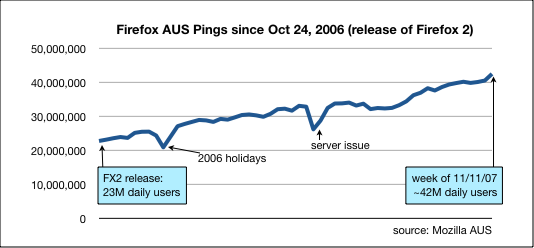 What that says is that averaged over a 7 day period, we've gone from 23M Active Daily Users in October 2006 to 42M a couple of weeks ago. (And we actually hit 48.8M yesterday, an all-time high that shows continued strong growth over the last few months.)
To get from the ADU number to our whole worldwide number of users, measured in terms of uniques in a given month, like most every web site does, we multiply ADU by 3. So for a couple of weeks ago, with 42M ADUs, we compute that we have something in excess of 126M unique monthly users.
This is a conservative multiplier (we think it could be more like 3.5) that we've gotten to by doing some of our own experiments, piecing together data we've received from sites who have done their own calculations, and then really testing them against the best common sense top-down tests we can. Here's one: take our estimate of monthly users (126M) and divide by the whole number of Internet users in the world (Internet World Stats puts the current at 1.2B) -- you end up with about 10.5%, which is lower than most reports of our global traffic share. You can do a bunch of mental gymnastics from there to account for higher-page-views-than-average for typical Firefox users, an overcounting of usage worldwide, etc -- but for our purposes here at Mozilla, we use a multiplier of 3 to approximate the number of worldwide Firefox users.
But, really, the absolute number of users around the world is less important than the trending. Are more people finding their way to Firefox? (yes!) How about in Brazil? (yes again) What happens over holidays? (people don't use their computers as much -- yay!) What happens when we do security updates? (usage goes down as anti-virus software updates get propagated, but recovers over the following week or 2)
---
Phew. That was a longer post than I thought it would be. More to come on topics like the annual autumn surge in usage, huge growth in China and Spain this year, and others.
What that says is that averaged over a 7 day period, we've gone from 23M Active Daily Users in October 2006 to 42M a couple of weeks ago. (And we actually hit 48.8M yesterday, an all-time high that shows continued strong growth over the last few months.)
To get from the ADU number to our whole worldwide number of users, measured in terms of uniques in a given month, like most every web site does, we multiply ADU by 3. So for a couple of weeks ago, with 42M ADUs, we compute that we have something in excess of 126M unique monthly users.
This is a conservative multiplier (we think it could be more like 3.5) that we've gotten to by doing some of our own experiments, piecing together data we've received from sites who have done their own calculations, and then really testing them against the best common sense top-down tests we can. Here's one: take our estimate of monthly users (126M) and divide by the whole number of Internet users in the world (Internet World Stats puts the current at 1.2B) -- you end up with about 10.5%, which is lower than most reports of our global traffic share. You can do a bunch of mental gymnastics from there to account for higher-page-views-than-average for typical Firefox users, an overcounting of usage worldwide, etc -- but for our purposes here at Mozilla, we use a multiplier of 3 to approximate the number of worldwide Firefox users.
But, really, the absolute number of users around the world is less important than the trending. Are more people finding their way to Firefox? (yes!) How about in Brazil? (yes again) What happens over holidays? (people don't use their computers as much -- yay!) What happens when we do security updates? (usage goes down as anti-virus software updates get propagated, but recovers over the following week or 2)
---
Phew. That was a longer post than I thought it would be. More to come on topics like the annual autumn surge in usage, huge growth in China and Spain this year, and others.
- We think there are at least 125,000,000 Firefox users in the world right now, give or take. That represents a doubling since Firefox 2 was released a little over a year ago, and significant growth in every country.
- At Mozilla we view market share as an important quantitative metric that can help us ask smarter questions and build better products, but it's only one of many
- We have systems here that tell us approximate number of daily users, and use that information to inform much of what we do.
- It's one indicator for how we're doing, how people like the products that we offer, and how well we're communicating. Not the only indicator; not the most important; but a significant indicator, nonetheless.
- It helps us ask questions that let us support our mission better. Including these (but there are many, many more):
- Why is our market share so high in Europe compared to the US? (50% higher, and more in some countries) Understanding why some countries exhibit higher usage than others can provide pointers to how to build a more relevant product for more users, and how to communicate about the product.
- Why are so many people in China using the English version of Firefox? (as much as 20%) Is it just that people use English for business? Is there some perceived difference? Understanding this can help us make both our Chinese language version better and even potentially our English language version for folks using it in China.
- Where can we use market share most effectively to help the spread of Web standards? (everywhere but Korea, for the moment)
- We believe Firefox is a superior product, and so we want as many people as possible to use it, or at least know there's a choice. While I'm happy that there's increased innovation in the browser space lately, I think that Firefox has the very best blend of features, extensibility, and simplicity, not to mention the fastest security patching in the industry, by a longshot.
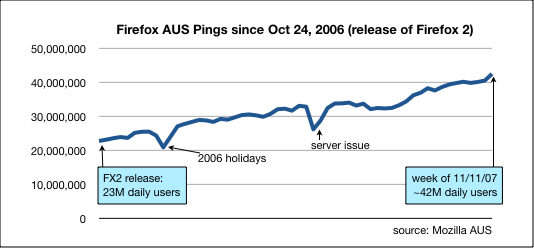 What that says is that averaged over a 7 day period, we've gone from 23M Active Daily Users in October 2006 to 42M a couple of weeks ago. (And we actually hit 48.8M yesterday, an all-time high that shows continued strong growth over the last few months.)
To get from the ADU number to our whole worldwide number of users, measured in terms of uniques in a given month, like most every web site does, we multiply ADU by 3. So for a couple of weeks ago, with 42M ADUs, we compute that we have something in excess of 126M unique monthly users.
This is a conservative multiplier (we think it could be more like 3.5) that we've gotten to by doing some of our own experiments, piecing together data we've received from sites who have done their own calculations, and then really testing them against the best common sense top-down tests we can. Here's one: take our estimate of monthly users (126M) and divide by the whole number of Internet users in the world (Internet World Stats puts the current at 1.2B) -- you end up with about 10.5%, which is lower than most reports of our global traffic share. You can do a bunch of mental gymnastics from there to account for higher-page-views-than-average for typical Firefox users, an overcounting of usage worldwide, etc -- but for our purposes here at Mozilla, we use a multiplier of 3 to approximate the number of worldwide Firefox users.
But, really, the absolute number of users around the world is less important than the trending. Are more people finding their way to Firefox? (yes!) How about in Brazil? (yes again) What happens over holidays? (people don't use their computers as much -- yay!) What happens when we do security updates? (usage goes down as anti-virus software updates get propagated, but recovers over the following week or 2)
---
Phew. That was a longer post than I thought it would be. More to come on topics like the annual autumn surge in usage, huge growth in China and Spain this year, and others.
What that says is that averaged over a 7 day period, we've gone from 23M Active Daily Users in October 2006 to 42M a couple of weeks ago. (And we actually hit 48.8M yesterday, an all-time high that shows continued strong growth over the last few months.)
To get from the ADU number to our whole worldwide number of users, measured in terms of uniques in a given month, like most every web site does, we multiply ADU by 3. So for a couple of weeks ago, with 42M ADUs, we compute that we have something in excess of 126M unique monthly users.
This is a conservative multiplier (we think it could be more like 3.5) that we've gotten to by doing some of our own experiments, piecing together data we've received from sites who have done their own calculations, and then really testing them against the best common sense top-down tests we can. Here's one: take our estimate of monthly users (126M) and divide by the whole number of Internet users in the world (Internet World Stats puts the current at 1.2B) -- you end up with about 10.5%, which is lower than most reports of our global traffic share. You can do a bunch of mental gymnastics from there to account for higher-page-views-than-average for typical Firefox users, an overcounting of usage worldwide, etc -- but for our purposes here at Mozilla, we use a multiplier of 3 to approximate the number of worldwide Firefox users.
But, really, the absolute number of users around the world is less important than the trending. Are more people finding their way to Firefox? (yes!) How about in Brazil? (yes again) What happens over holidays? (people don't use their computers as much -- yay!) What happens when we do security updates? (usage goes down as anti-virus software updates get propagated, but recovers over the following week or 2)
---
Phew. That was a longer post than I thought it would be. More to come on topics like the annual autumn surge in usage, huge growth in China and Spain this year, and others.